Mythos changed the calculus. What used to take a skilled researcher weeks — identifying a new CVE or reading a CVE advisory, understanding the affected subsystem, crafting a working exploit — now takes an AI agent a few hours and costs roughly $2,000 per working exploit.
The AI-assisted Copy Fail (CVE-2026-31431) made it vividly concrete: a 732-byte Python script, no root required, exploiting a zero-day vulnerability since 2017, and fully weaponized before most fleet operators had even read the advisory.
The uncomfortable implication isn’t that attackers are smarter. It’s that the patching model is structurally broken for edge and IoT devices. Exploit availability now outruns patch deployment by a factor of days to weeks. That gap is the attack surface.

Industry response to old-school CVEs and exploits has been to patch faster. Tighter OTA pipelines, shorter validation cycles, more aggressive rollouts. That’s necessary — but it misses the structural problem. Faster patching shrinks the window; it doesn’t close it. And for constrained edge fleets spread across geographies, “faster” has real operational and financial ceilings.
The right question isn’t “how do we patch before attackers exploit?”. It’s “how do we make the exploit fail, even when we haven’t patched yet?”.
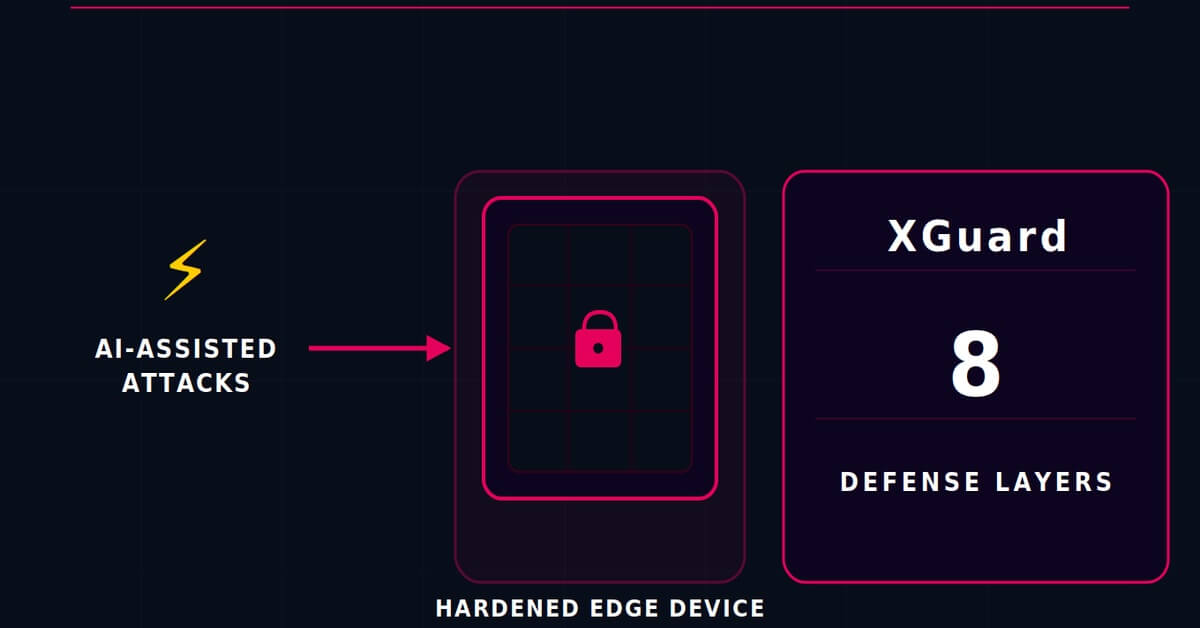
That reframe is the foundation of XGuard. Rather than betting on outrunning the exploit timeline, XGuard builds deterministic barriers that force the attack to fail at early stages of the kill chain - even if the underlying CVE hasn’t been patched. The goal is not to detect and respond; it’s to break enough of the kill chain that exploitation becomes a dead end.
Eight Independent Barriers
XGuard ships as eight independent enforcement modules. “Independent” matters: each layer can stop a different attack vector. An attacker that somehow bypasses one faces the next. There’s no single policy to disable, no single process to remove. Each module enforces a different contract about what the device is allowed to do.
Binary Allowlist
An exact cryptographic inventory of every executable permitted to run; built automatically, on a binary level (no source code or compilation required), not maintained manually. Any binary or script or library not in that inventory is blocked at execution. Including binaries dropped by a running exploit, Python scripts invoked via a shell, or payloads written to /tmp. Root cannot override this: the allowlist is enforced in kernel space by a signed policy.
This is the layer that would have stopped Copy Fail at step one — the 732-byte script simply couldn’t execute.
Deep Python Inspection
Python is the attacker’s best friend on modern edge devices — stdlib only, no compilation step, powerful socket and syscall access. Deep Python Inspection validates not just that the python3 binary is allowed, but what it’s importing at runtime. Unlisted modules are blocked at import. Interactive interpreter usage is controlled. Dynamic .pyc caching is hardened to prevent cache-poisoning attacks.
Data Protection (Encryption at Rest)
Files on flash storage are encrypted against unauthorized physical access. An attacker with hardware access - or one who has found a read primitive - cannot extract credentials, keys, or configuration. This layer protects the device as a physical object, not just as a running system, and prevents a stolen or recovered device from becoming a bridge into the broader infrastructure.
File & Directory Protection
A declarative policy specifying which files and directories may be read, written, or deleted — and by which processes. Sensitive targets like SSH authorized keys, /etc/passwd, certificate stores, and application configs are locked. A payload that tries to write a new SSH key for persistence is blocked. An exfiltration routine that tries to read a credentials file is blocked. This closes the write-then-execute gap that most application-layer attacks depend on.
Execution Access Control
Only permitted process pairs may spawn each other. This is the answer to living-off-the-land (LotL) attacks, where an adversary abuses legitimate binaries - spawning /bin/sh from a compromised daemon, calling curl to exfiltrate data, or using crontab for persistence. Under XGuard, if your application daemon isn’t permitted to launch a shell, it simply can’t - even at root. The whitelist is process-pair specific, not just binary-level.
Process Access Control
Cross-process memory access is blocked. This prevents credential-harvesting attacks where a compromised process reads the memory of a privileged neighbor - extracting tokens, session keys, or plaintext secrets. It also blocks debugging-based attack primitives and process memory writes: ptrace access, /proc/[pid]/mem read/write operations, and similar runtime inspection techniques attackers use to escalate after gaining an initial foothold.
Peripheral Device Access Control
Peripheral access - cameras, sensors, microphone, storage interfaces - is gated to authorized processes only. A compromised process cannot access hardware it has no business touching. This matters especially in IoT contexts where the physical-world interface is often the actual attack target: disabling a sensor or manipulating a camera feed. The policy is enforced at the device node level, not the application level.
Control Flow Integrity (CFI)
Optional, CFI layer – applicable to indirect calls and returns – hardens the compiled binary against return-oriented programming (ROP) and jump-oriented programming (JOP); the techniques attackers use when they can’t inject new code but can redirect existing code. By enforcing an auto-generated binary-derived call graph at runtime, CFI ensures that even a memory corruption bug cannot redirect execution to an attacker-controlled code path.
The Tamper-Proof Problem
Here’s the attack scenario every security tool has to answer: what happens after root?
Most enforcement mechanisms - SELinux, AppArmor, ASLR - are disabled or bypassed with a single privileged command. setenforce 0. sysctl kernel.randomize_va_space=0. Root is, by definition, the highest privilege level on the system. If your security policy lives in user space and is enforced by the OS, root can undo it.
XGuard’s answer is to move the policy off the device’s trust boundary entirely. Enforcement policies are cryptographically signed with an external private key that never touches the device. Modifying a running XGuard policy - even after achieving root - requires that external key. An attacker who has fully rooted the device still cannot disable or modify the enforcement rules. This is a fundamentally harder problem class than bypassing in-process security controls.
Tamper-proof comparison:
- SELinux →
setenforce 0(one command, root required) - AppArmor → profiles load in user space, trivially bypassed at root
- ASLR →
sysctl kernel.randomize_va_space=0(one command) - XGuard → policy requires external private key to modify. Root alone is insufficient.
What This Actually Changes Operationally
The practical consequence of layered deterministic enforcement is that the relationship between “CVE disclosed” and “fleet at risk” is broken. When an exploit can’t execute - because the binary is blocked, the Python import is denied, the shell spawn is rejected, and the policy can’t be disabled - the existence of the CVE stops being an emergency.
| WITHOUT XGUARD | WITH XGUARD |
|---|---|
| ✕ Exploit available within hours of CVE disclosure | ✓ Kill chain blocked at multiple independent points |
| ✕ Every unpatched device fully exposed until fleet is updated | ✓ Device protected even before patch deployment |
| ✕ Emergency patches are costly | ✓ CVEs safely deferred to next planned firmware release |
| ✕ Validation cycles make rapid patching impractical at scale | ✓ Planned, tested updates replace emergency patch campaigns |
| ✕ Root compromise disables security controls | ✓ Policy survives root compromise — requires external key |
The patching problem doesn’t disappear - vulnerabilities still need to be fixed. But the timeline pressure changes completely. Instead of an emergency patch campaign within 48 hours, teams can fold the fix into the next planned firmware release, with full validation cycles and controlled rollout. For large fleets, that difference is measured in engineering weeks and significant operational cost per incident.
The Overhead Question
The reasonable concern with enforcement controls is performance. XGuard runs as a sub-1MB agent with under 1% CPU overhead at runtime, integrated at build time without source code access. It’s transparent to R&D teams and existing toolchains. The enforcement happens in kernel or user space, but the policy compilation and signing happens offline. No architecture changes are required.
The Structural Argument
The threat that AI represents isn’t a temporary spike in attacker capability that will subside. AI-assisted exploitation is a permanent capability shift. The economics of exploit development have been altered - working exploits are now a commodity, available quickly and cheaply for published CVE. Moreover, AI-assisted tools have already demonstrated their ability to find and exploit zero-day vulnerabilities, as well known CVEs. Defenses built on the assumption that attackers need weeks to weaponize a vulnerability are now structurally mismatched to the threat environment.
Deterministic hardening - enforcing what the device is allowed to do, regardless of what vulnerabilities exist in its software - is the architecture that matches the threat model. The attack fails not because it was detected, or because the defender was fast enough, but because the action it requires is structurally impossible on a hardened device.
Questions about XGuard deployment or architecture: [email protected]
